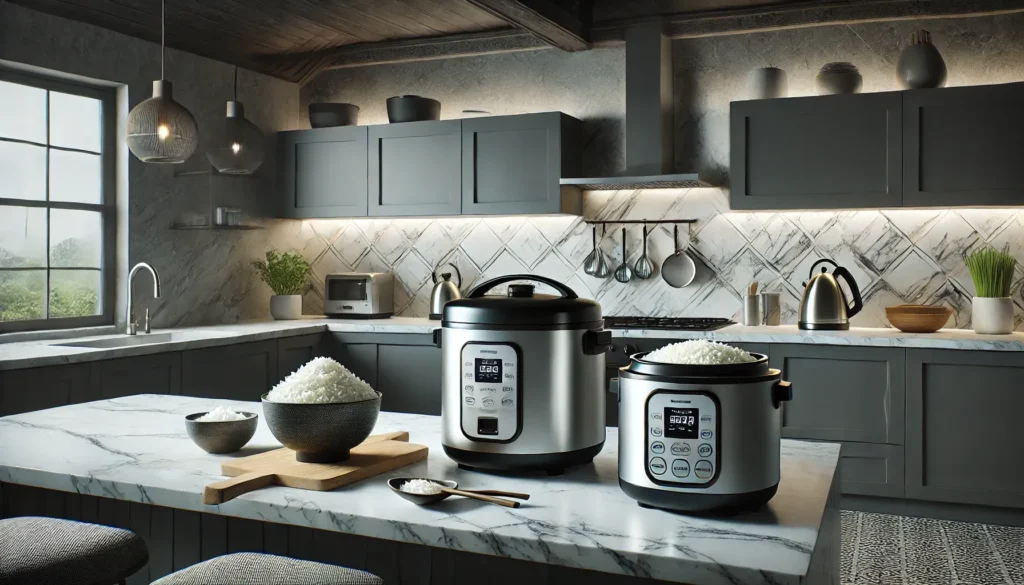
Rice cooker choices can be a real weeknight lifesaver if you cook rice even once or twice a week. Measure, rinse if you like, press a button, and you get consistent results without babysitting a saucepan.
The tricky bit is choosing the right model for your home. UK kitchens vary wildly—tiny flat worktops, family-sized houses, and open-plan living where steam and beeps are suddenly very noticeable. Some households want a compact cooker for basmati and jasmine. Others want a smarter “fuzzy logic” model for sushi rice, brown rice, and porridge. And plenty of people just want the easiest thing possible to clean.
If you’re building a low-fuss weekday cooking setup, this guide pairs nicely with a few other kitchen staples. You might also like our round-up of the best air fryers in the UK and, for hands-off batch cooking, our guide to the best slow cookers.
This guide focuses on UK-friendly picks (power, plugs, availability) and explains what features actually matter, so you can buy once and enjoy perfect rice for years.
Best Rice Cooker UK Quick Picks Top Three
Best small rice cooker (premium compact): Yum Asia Panda Mini – Great for 1–3 people, featuring smart cooking programs and a high-quality bowl. yum-asia.com+1
Best budget family option: Russell Hobbs 19750 – Big capacity, simple controls, strong value if you just want straightforward rice. uk.russellhobbs.com
Best all-rounder: Yum Asia Sakura – Family-friendly size with fuzzy logic for more consistent results across rice types. yum-asia.com+1
If you’re choosing your first rice cooker, focus on capacity and cleaning first. The best rice cooker UK option for you is the one you’ll actually use weekly, not the one with the longest spec list.
Best Rice Cooker UK Comparison Table
Note: Specs vary by retailer and model revision. If a spec isn’t clearly stated by the manufacturer/retailer, I’ve marked it as “Not stated”. Key specs referenced from manufacturer/official retailer listings where available. JAPAN PLAZA UK+5yum-asia.com+5yum-asia.com+5
To make choosing the best rice cooker UK shoppers can buy easier, here’s a quick side-by-side comparison of the most popular options.
| Model | Best for | Capacity (rice cooker) | Wattage | Type | Keep warm | Steamer basket | Notes |
|---|---|---|---|---|---|---|---|
| Yum Asia Panda Mini | Small kitchens, quality results | 0.6L (3.5 cup uncooked) | 350W | Fuzzy logic | 24h | Yes | Ceramic-coated bowl; compact yum-asia.com+1 |
| Russell Hobbs 19750 | Budget + batch cooking | 1.8L | 700W | Basic switch | Not stated | Yes | Dishwasher-safe parts listed uk.russellhobbs.com |
| Yum Asia Sakura | Families + versatility | 1.5L (8 cup uncooked) | 860W | Fuzzy logic | Not stated | Yes | Multi-cooker modes too yum-asia.com+1 |
| Reishunger Digital 1.5L | Programmes + convenience | 1.5L | Not stated | Digital programmes | Not stated | Yes | Often marketed with multi-phase tech CookGear UK+1 |
| Zojirushi NS-TSQ10 | Premium “set-and-forget” | 1.0L | 570–610W | Fuzzy logic | Yes | Not stated | Excellent keep-warm reputation JAPAN PLAZA UK+1 |
| Panasonic SR-DF101 | Mid-size fuzzy logic | 1.0L | 750W | Fuzzy logic | 5 hrs | Yes | Simple menus, solid brand panasonic.com |
| Instant Pot Duo 5.7L | One-pot meals + rice | 5.7L pot | 1000W | Multi-cooker | Yes | Not stated | Rice + pressure cooking amazon.co.uk+1 |
| Tefal Classic-style | Simple rice + steaming | Not stated | Not stated | Basic switch | Not stated | Yes | Typically glass lid + steam tray Flying Blue Store+1 |
| Reishunger Digital Mini / similar | Small + cheaper than Panda | 0.6L | 350W | Digital | Not stated | Yes | Compact, multiple programmes amazon.co.uk+1 |
How we chose these rice cookers
We focused on the things that genuinely affect day-to-day use: capacity, consistency across rice types, ease of cleaning, and long-term running costs. If you’re also trying to save time during the week, our meal prep for beginners guide is a useful companion read.
I selected these models based on:
- UK relevance: commonly available to UK shoppers and suitable for UK power (and ideally UK plugs).
- Clear feature benefits: capacity, cooking modes, keep warm behaviour, and cleaning practicality.
- A spread of budgets: from basic switch cookers to premium fuzzy logic models.
- Credible spec sources: prioritising manufacturer sites and established retailers/review outlets where possible. yum-asia.com+2uk.russellhobbs.com+2
Important: this is a research-based buying guide. I’m not claiming hands-on testing or lab results.
Our aim is simple: help you choose the best rice cooker UK option for your kitchen size, budget, and the types of rice you actually eat.
What Type of Rice Cooker Should You Buy
Basic switch rice cookers (cheap and cheerful)
These are the classic “cook → click → warm” machines. They’re usually affordable, simple, and perfectly fine for everyday white rice.
Best for: value seekers, students, big batches, people who don’t need lots of rice types.
Trade-off: less precision for brown rice, sushi rice, or porridge.
Fuzzy logic rice cookers (more consistent results)
Fuzzy logic models use sensors and programmes to adjust cooking time and temperature. In plain English: they’re more forgiving and more consistent, especially across different rice types.
Best for: anyone picky about texture, households cooking sushi rice, brown rice, or mixed grains.
Trade-off: higher price, sometimes more menus to learn.
Multi-cookers (pressure cookers that also do rice)
If you want one appliance that can do rice, stews, beans, pasta, soups, and batch cooking, a multi-cooker can be great.
Best for: meal prep, busy families, one-pot cooking.
Trade-off: it’s bulkier, and “excellent rice” may require a bit more dialling in than a dedicated rice cooker.
What to look for in UK homes
Capacity: 1-2 people vs family cooking
For most households, the best rice cooker UK size is either a compact 0.6L model for 1-3 people or a 1.0-1.5L cooker for family portions and leftovers.
A surprisingly common mistake is buying too big “just in case” and then leaving it on the counter forever. As a rough guide:
- 0.6L mini cookers: ideal for 1-3 people, small worktops, and frequent fresh rice.
- 1.0L-1.5L cookers: the sweet spot for families or people who meal prep.
- Very large cookers: useful if you batch cook constantly, but they take space.
Worktop space, storage and cord length
In flats, a compact footprint matters as much as capacity. Also check:
- whether the lid opens upwards (needs overhead space)
- whether parts are easy to store (steam basket, ladle, measuring cup)
Noise, steam and kitchen ventilation
Rice cookers aren’t loud, but:
- Some play tunes (you can’t un-hear this once you know).
- Steam release can be noticeable in small kitchens—especially if your cooker vents near cupboards.
Easy cleaning (inner lid, bowl coating, accessories)
If you want “low maintenance”, prioritise:
- a detachable inner lid
- a non-stick or ceramic-coated bowl
- minimal fiddly crevices where starchy water dries
Rice types: basmati, jasmine, sushi, brown, porridge
If you mostly cook basmati and jasmine, a basic model can do the job. If you regularly cook brown rice, mixed grains, or porridge, fuzzy logic programmes are genuinely helpful.
Running costs in the UK and maintenance tips
Running costs are usually modest, but keeping warm can add up if you leave it on for hours. A truly best rice cooker UK pick will balance consistent results with sensible energy use and easy cleaning
Typical electricity cost per cook (simple estimate)
Using Ofgem’s capped electricity unit rate for 1 Jan–31 Mar 2026 (27.69p/kWh), here’s a simple running-cost estimate.
- 700W cooker for ~30 minutes: 0.7 kW × 0.5 h = 0.35 kWh → ~10p
- 350W cooker for ~40 minutes: 0.35 kW × 0.67 h ≈ 0.23 kWh → ~6p
- 860W cooker for ~35 minutes: 0.86 kW × 0.58 h ≈ 0.50 kWh → ~14p
Real usage varies (rice type, portion size, soak time, keep warm). But for most households, a rice cooker is pennies per cook, not pounds.
Maintenance checklist (weekly/monthly)
- After each use: wash bowl, steam basket, and spatula; wipe condensation.
- Weekly: clean the lid area and steam vent; check for stuck starch residue.
- Monthly: inspect the bowl coating and avoid abrasive scourers.
How to reduce costs and extend lifespan
- Use the right water line for your rice type (too much water = longer cook time).
- Avoid metal utensils in non-stick/ceramic bowls.
- If you meal prep, cool and store rice safely (see below).
Food safety note (UK): If you’re keeping leftovers, cool cooked rice quickly and don’t reheat more than once. Also, don’t leave rice sitting in the cooker to cool down. Food Standards Agency+1
Best rice cookers in the UK
Below are our top picks for the best rice cooker UK households can rely on for consistent results, from compact flats to family kitchens.
1. Yum Asia Panda Mini – Best small premium pick
Best for: Small kitchens and 1–3 people who still want “proper” rice texture.
The Panda Mini is one of the most popular compact fuzzy logic rice cookers in the UK market. It’s designed for smaller portions, but it’s not a “toy” appliance—features like fuzzy logic control and multiple rice settings are exactly what makes rice more consistent.
Pros
- Compact footprint for flats and smaller worktops
- Fuzzy logic cooking helps with consistency
- Good range of rice and multi-cook functions
Cons
- Too small if you batch cook for a family
- Premium price for a mini size
Key specs
- Capacity: 0.6L / 3.5 cup uncooked yum-asia.com
- Wattage: 350W Good Food
- Keep warm: up to 24 hours (stated by manufacturer) yum-asia.com
- Modes include rice + steam/porridge/slow cook (varies by programme) yum-asia.com
Who it’s for
- Couples, solo cooks, and anyone who wants fresh rice often
- People who care about texture (not just “edible rice”)
Who it’s not for
- Large families or serious bulk meal-preppers
Alternatives
- Reishunger Digital Mini (similar capacity, often cheaper depending on deals) amazon.co.uk+1
- Panasonic SR-DF101 (bigger capacity, different feature set) panasonic.com
- Russell Hobbs 19750 (bigger and cheaper, but less “smart”) uk.russellhobbs.com
2. Russell Hobbs 19750 — Best budget family option
Best for: Straightforward rice (and steaming) for families on a budget.
This is the kind of rice cooker many UK households start with: simple, affordable, and big enough to feed a crowd. If you mainly cook white rice and want a steamer basket for veg, it’s excellent value.
Pros
- Large 1.8L capacity for batch cooking
- Simple controls (easy for anyone in the house)
- Steamer basket included; dishwasher-safe parts stated uk.russellhobbs.com
Cons
- Less precise for brown rice or sushi rice
- Texture can be less consistent than fuzzy logic models
Key specs
- Capacity: 1.8L uk.russellhobbs.com
- Wattage: 700W uk.russellhobbs.com
- Steaming basket: Yes uk.russellhobbs.com
- Keep warm: Yes (function present) AO
Who it’s for
- Families and shared houses
- Anyone who wants big-batch rice without spending a lot
Who it’s not for
- People who want “restaurant-perfect” sushi rice texture
- Tiny kitchens where a large footprint is a deal-breaker
Alternatives
- Tefal Classic-style cookers (similar simplicity, varies by model) Flying Blue Store+1
- Yum Asia Sakura (more expensive, much smarter cooking) yum-asia.com+1
- Instant Pot Duo (if you want one appliance for more meals) amazon.co.uk
3. Yum Asia Sakura — Best all-rounder for families
Best for: Families who want consistency across multiple rice types.
If you cook rice often—and you switch between basmati, jasmine, brown rice, and porridge—the Sakura is built for that. It’s a bigger, more capable fuzzy logic model than the Panda, with a family-friendly capacity.
Pros
- Strong all-round performance on different rice types (by design)
- Family capacity without feeling industrial
- Extra modes beyond rice (useful, not gimmicky for many homes)
Cons
- Costs more than basic cookers
- Takes up more space than mini models
Key specs
- Capacity: 1.5L / 8 cup uncooked yum-asia.com+1
- Wattage: 860W yum-asia.com+1
- Fuzzy logic: Yes yum-asia.com
Who it’s for
- Busy households that want reliable results with minimal effort
- People who cook more than one type of rice regularly
Who it’s not for
- Occasional rice eaters who’d be happy with a basic switch cooker
- Very small kitchens with limited storage
Alternatives
- Zojirushi NS-TSQ10 (premium brand, excellent keep-warm reputation) Expert Reviews+1
- Reishunger Digital 1.5L (feature-packed competitor) https://www.reishunger.de+1
- Panasonic SR-DF101 (smaller fuzzy logic option) panasonic.com
4. Reishunger Digital Rice Cooker 1.5L — Best feature-packed alternative
Best for: People who want lots of programmes and a modern, “meal-prep friendly” setup.
Reishunger’s digital models are often marketed around multi-phase cooking programmes and convenience features. If you like pressing a specific programme for sushi rice, wholegrain, porridge, etc., this style of rice cooker can be a great fit.
Pros
- Digital programmes for different rice styles
- Family-friendly capacity
- Typically includes timer/keep warm features (check listing)
Cons
- Specs can vary by retailer and version
- Not always as widely supported in the UK as the biggest brands
Key specs
- Capacity: 1.5L (commonly stated) https://www.reishunger.de+1
- Programmes: multiple programmes (often 12; varies by version) https://www.reishunger.de
- Wattage: Not stated (varies by listing/version; verify before purchase)
Who it’s for
- People who want “press the exact button for the exact rice”
- Meal preppers who want timer convenience
Who it’s not for
- Anyone who wants a super-simple one-switch machine
- Buyers who don’t want to cross-check specs before purchasing
Alternatives
- Yum Asia Sakura (very established in this category) yum-asia.com+1
- Russell Hobbs 19750 (simpler and cheaper) uk.russellhobbs.com
- Instant Pot Duo (more versatile overall) amazon.co.uk
5. Zojirushi NS-TSQ10 — Best premium Japanese-style cooker
Best for: People who cook rice constantly and want top-tier keep-warm convenience.
Zojirushi is a legendary name in rice cookers. In the UK, availability can be more niche and prices are higher—but the brand’s reputation for excellent keep-warm performance is a big reason people buy it. Expert Reviews
Pros
- Strong reputation for keep-warm quality (great for leftovers) Expert Reviews
- Timer function for set-and-forget meals
- Detachable inner lid mentioned for easier cleaning yum-asia.com
Cons
- Expensive compared to UK mainstream brands
- Make sure you’re buying a UK plug / correct voltage version
Key specs
- Capacity: 1.0L (NS-TSQ10) JAPAN PLAZA UK
- Power consumption: 570–610W (cooking) JAPAN PLAZA UK
- Keep warm consumption: ~29W JAPAN PLAZA UK
Who it’s for
- Rice lovers who want premium convenience and consistency
- Anyone who values keep-warm for lunch the next day
Who it’s not for
- Tight budgets
- People who only cook rice occasionally
Alternatives
- Yum Asia Sakura (premium results at a typically lower price point) yum-asia.com+1
- Panasonic SR-DF101 (fuzzy logic, more mainstream pricing) panasonic.com
- Reishunger Digital 1.5L (programme-heavy alternative) https://www.reishunger.de+1
6. Panasonic SR-DF101 — Best mid-size fuzzy-logic alternative
Best for: People who want fuzzy logic from a major appliance brand in a manageable size.
Panasonic’s SR-DF101 offers fuzzy logic cooking with a straightforward set of menus. It’s a sensible “middle ground” pick: more guidance than a basic switch cooker, less complexity (and usually less cost) than premium niche models.
Pros
- Fuzzy logic cooking
- Useful core menus (white rice, quick cook, porridge, brown rice) panasonic.com
- Mid-size capacity works for many homes
Cons
- Keep-warm time listed as 5 hours (fine for dinner, less ideal overnight) panasonic.com
- Feature set may feel limited versus programme-heavy competitors
Key specs
- Capacity: 1.0L panasonic.com
- Wattage: 750W panasonic.com
- Keep warm: 5 hours panasonic.com
Who it’s for
- Households that want better consistency than basic cookers
- People who don’t want loads of extra modes
Who it’s not for
- Large families who need bigger capacity
- Anyone who wants long keep-warm for next-day rice
Alternatives
- Russell Hobbs 19750 (bigger, cheaper, less “smart”) uk.russellhobbs.com
- Yum Asia Panda Mini (smaller, premium mini) Good Food+1
- Yum Asia Sakura (bigger, more versatile) yum-asia.com+1
7. Instant Pot Duo 5.7L — Best multi-cooker that also nails rice
Best for: Households that want one appliance for rice and loads of other meals.
If you’re short on space (or just hate having lots of single-use gadgets), a multi-cooker can replace several appliances. Instant Pot models are popular in the UK for batch cooking and “one-pot” dinners, and they can cook rice well once you learn your preferred ratio and programme.
Pros
- Extremely versatile: pressure cook, slow cook, sauté, and more
- Great for meal prep and bulk cooking
- Clear UK availability and support docs/manuals Instant Pot UK+1
Cons
- Bulkier than a dedicated rice cooker
- Rice results depend more on technique (ratio, rinse, rest time)
Key specs
- Capacity: 5.7L amazon.co.uk
- Wattage: 1000W amazon.co.uk
- Safety guidance and fill limits are important (especially with expanding foods like rice) Instant Pot UK
Who it’s for
- Meal preppers and busy families
- Anyone who wants rice, curries, chilli, stews and more in one pot
Who it’s not for
- People who only want rice (a dedicated cooker is simpler)
- Very small kitchens where storage is a challenge
Alternatives
- Yum Asia Sakura (dedicated rice cooker experience) yum-asia.com+1
- Russell Hobbs 19750 (simple and big for rice + steam) uk.russellhobbs.com
- Zojirushi NS-TSQ10 (premium rice-first approach) JAPAN PLAZA UK+1
8. Tefal Classic-style rice cookers — Best simple “set and forget”
Best for: People who want classic rice cooker simplicity with steaming.
Tefal’s classic rice cookers (model numbers vary by market and retailer) tend to follow the same reliable formula: cook/warm indicator lights, removable bowl, and a steam basket. If you want the “traditional” experience from a mainstream brand, this category is worth a look—just double-check the exact model specs.
Pros
- Straightforward controls
- Usually includes steaming
- Often easy to clean with removable bowl
Cons
- Fewer advanced programmes
- Specs can vary depending on the exact model/version
Key specs
- Capacity/wattage: Not stated (varies by model; verify before purchase)
- Typical feature set: cook + warm + steaming, removable bowl Flying Blue Store+1
Who it’s for
- Anyone who wants “press button, get rice”
- Homes that also want to steam veg while rice cooks
Who it’s not for
- People who want sushi rice precision or lots of grain-specific programmes
Alternatives
- Russell Hobbs 19750 (clear UK specs and value) uk.russellhobbs.com
- Panasonic SR-DF101 (fuzzy logic upgrade) panasonic.com
9. Reishunger Digital Mini (and similar mini digitals) — Best small-budget alternative
Best for: Small households that want programmes without paying “premium mini” prices.
If the Panda Mini is your dream but the price isn’t, mini digital cookers like Reishunger’s can be a sensible compromise: compact size, multiple programmes, and easy daily use.
Pros
- Compact (good for flats)
- Multiple programmes
- Often competitively priced during sales
Cons
- Not always as “polished” as premium brands (menus, lid/vent design)
- Specs can vary by listing/version
Key specs
- Capacity: 0.6L (commonly listed) amazon.co.uk+1
- Wattage: 350W (commonly listed) amazon.co.uk+1
Who it’s for
- Couples and solo cooks who want compact convenience
- People who like programmes (brown rice, porridge, etc.)
Who it’s not for
- Families who need large batches
Alternatives
- Yum Asia Panda Mini (premium compact benchmark) Good Food+1
- Panasonic SR-DF101 (larger capacity, mainstream brand) panasonic.com
Common mistakes and how to avoid them
- Buying too big for your worktop
If it lives in a cupboard, you’ll use it less. Match capacity to real life. - Skipping the rinse (when your rice needs it)
Basmati and sushi rice often improve with a rinse to remove excess starch. (Not mandatory, but usually worth it.) - Lifting the lid too early
Rice needs a rest phase. Even basic cookers benefit from 5–10 minutes on warm after cooking. - Using abrasive cleaning tools
Non-stick/ceramic coatings last far longer if you avoid scouring pads and metal utensils. - Unsafe leftover handling
Cool rice quickly, refrigerate, and reheat properly—don’t leave it sitting in the cooker to cool, and don’t reheat more than once. Food Standards Agency+1
Troubleshooting rice that is too wet, too dry, sticking or burning
Rice is too wet/mushy
- Use slightly less water next time (especially if you rinsed heavily).
- Let rice rest longer with the lid closed after cooking.
Rice is too dry
- Add a touch more water next time.
- Check you’re using the correct measuring cup markings for your cooker (some use 180ml cups).
Rice sticks to the bowl
- Avoid leaving rice on warm too long (especially in basic models).
- Ensure the bowl coating is intact and you’re not scraping it with metal utensils.
Bottom layer is browned/burnt
- Too little water is the common cause.
- Also check if the cooker sits unevenly or the heating plate area has residue.
Rice is undercooked
- Confirm you didn’t exceed the maximum capacity lines.
- For brown rice, use the specific brown rice programme if available.
If you want the best balance of results, capacity, and everyday ease, Yum Asia Sakura is the standout all-rounder for many UK households, especially if you cook multiple rice types and want consistency without thinking too hard about it. yum-asia.com+1
If you live in a flat or only cook rice for 1-3 people, Yum Asia Panda Mini is the compact pick that still feels “premium”. Good Food+1
And if you just want maximum value with big capacity, Russell Hobbs 19750 is the practical budget buy. uk.russellhobbs.com
SECCIÓN DE PREGUNTAS FRECUENTES
1. Are fuzzy logic rice cookers worth it?
For many people, yes, especially if you cook more than just white rice. Fuzzy logic cookers adjust heat and time based on sensors, which tends to improve consistency for brown rice, sushi rice, and porridge. If you only cook basmati once a week, a basic switch cooker can be enough. If rice is a staple, fuzzy logic is usually money well spent.
2. What size rice cooker do I need for a family of four?
A 1.0L to 1.5L rice cooker is typically a comfortable range for a family of four, especially if you want leftovers or meal prep. Mini 0.6L models can work for smaller portions but will feel limiting if you’re feeding multiple people regularly. Also consider whether you’ll cook rice as a side or as the main bulk of the meal.
3. How much does a rice cooker cost to run in the UK?
Usually just a few pence per cook. Using Ofgem’s capped electricity unit rate for early 2026 (27.69p/kWh), a 700W cooker running for ~30 minutes costs roughly 10p. Ofgem
Keep-warm time can add a little more, but for most households it’s still low compared to using an oven or hob for longer periods.
4. Can rice cookers cook brown rice properly?
Yes, especially models with a dedicated brown rice programme. Brown rice generally needs more time and controlled heat. Basic switch cookers can still cook brown rice, but results may be less consistent and sometimes require experimentation with water ratio and rest time. If brown rice is a regular in your house, choosing a cooker with a brown rice mode is a smart move.
5. Can I leave rice on “keep warm” overnight?
Food safety guidance in the UK focuses on cooling and storage rather than leaving rice warm for long periods. The Food Standards Agency advises cooling rice quickly, refrigerating, and not reheating more than once. Food Standards Agency+1
If you need rice the next day, it’s usually safer to cool it quickly and fridge it, then reheat thoroughly until steaming hot.
6. Do I need to rinse basmati rice before using a rice cooker?
You don’t have to, but rinsing often improves texture by removing excess surface starch. Many people find rinsed basmati comes out fluffier and less sticky. If you rinse, shake off excess water and follow your cooker’s water lines or adjust slightly—rinsed rice can sometimes need a touch less added water depending on the cooker.
7. What’s the difference between “cups” and litres on rice cookers?
Many rice cookers measure “cups” using a 180ml measuring cup (common in rice cookers), not a UK mug. Litres usually refer to the bowl volume, while “cups” often refer to uncooked rice capacity. Always use the included measuring cup and the bowl’s internal water lines for the most consistent results—especially when switching rice types.
8. Is a ceramic bowl better than non-stick?
It depends. Ceramic-coated bowls can be appealing for people who want alternatives to traditional non-stick coatings, and they can be easier to clean when new. However, durability varies by brand and care (avoid metal utensils and abrasive scrubbers either way). A high-quality non-stick bowl can also last years if treated gently. Prioritise the overall build quality and cleaning design.
9. Can I steam vegetables while cooking rice?
Often yes. Many rice cookers include a steam basket so you can cook veg while the rice runs. This works best for quick-steaming veg (broccoli, green beans, sliced carrots). For thicker items, you may need to start the steam later or cut smaller. It’s a great “weekday dinner” trick that saves hob space and reduces washing up.