You know that moment when you make a proper cuppa… and it tastes a bit swimming-pool-ish? Or when your kettle looks like it’s been dusted with chalk? That’s usually when people in the UK start Googling “Best Water Filter Jug UK 2026”.
Before we get into the juicy stuff (quick picks, comparisons, and which jug fits your fridge door), here’s a quick reality check: UK tap water is generally very safe to drink—so most of the time, buying a filter jug is about taste, kettle limescale, and convenience, not panic. water.org.uk
Affiliate note (keep it compliant): If you buy through links on this site, we may earn a commission at no extra cost to you. Prices are shown as placeholders and may change daily.
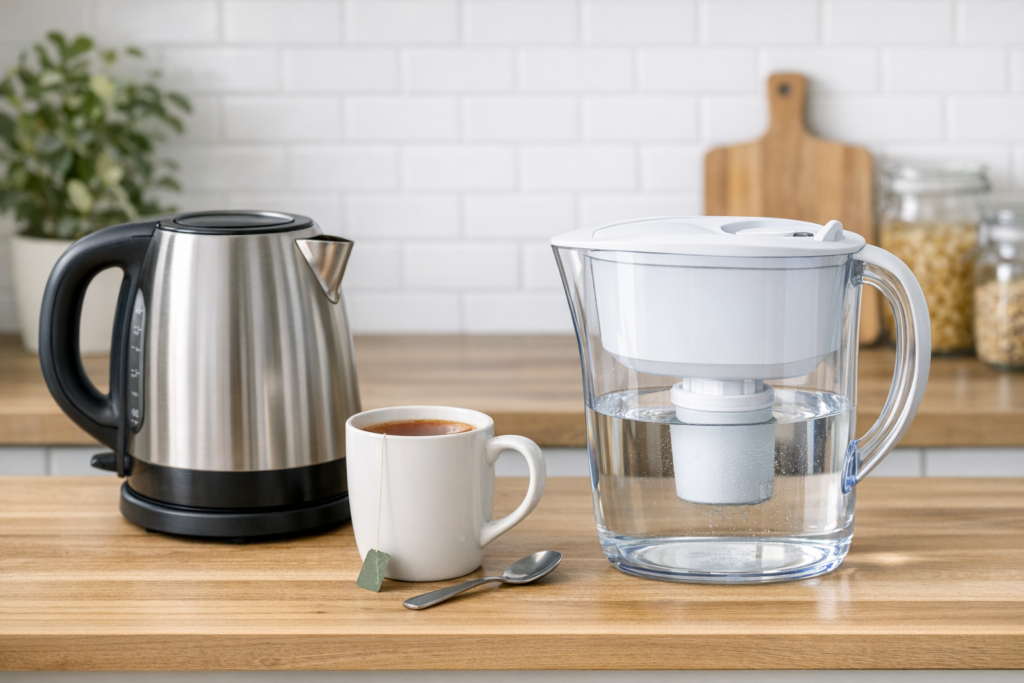
[Image 1 goes after this paragraph: A bright UK kitchen scene: kettle, tea mug, and a filter jug on the counter (no brand logos). Alt text: “Water filter jug beside a kettle and tea mug in a UK kitchen.”]
Quick heads-up: UK tap water is safe—so why filter at all?
Taste, kettle scale, and “tea scum”: the real reasons people buy jugs
Think of a filter jug like a bouncer for flavour. It’s not there because your tap water is “bad”—it’s there to stop a few unwanted guests from ruining the party: chlorine taste/odour, and in many areas, some of the stuff that contributes to temporary hardness (the bit that loves turning into kettle limescale). Drinking Water Inspectorate+1
In the UK, hard water is common in lots of places (hello South-East), and hard water can leave:
- more scale in kettles and coffee machines,
- a film/scum on hot drinks,
- soap that doesn’t lather like you want it to. Drinking Water Inspectorate+1
When a jug filter isn’t the right solution
If your goal is health protection (especially for someone immunocompromised), the advice can be different—some NHS materials caution that jug filters can harbour bacteria if not managed properly. Sandwell and West Birmingham NHS Trust
And if you’re dealing with a specific contamination concern, your best first step is usually to contact your water supplier or follow official notices—because in rare cases, a boil-water notice is not something a jug filter “fixes”. Drinking Water Inspectorate+1
Quick picks for 2026 (by household type)
These are 2026-ready picks based on what tends to perform well in UK testing/review roundups and what UK households actually care about: tea taste, kettle scale, fridge fit, and cartridge costs. For independent lab-style testing, consumer organisations like Which? are a strong reference point. Which?+1
Best all-rounder for most UK homes
- A Brita-style jug with ion exchange + carbon
Why: balanced taste improvement + useful for hard water kettle use.
Best for very hard water + kettle protection
- A “hard water / limescale” cartridge system
Why: targets the “kettle crust” problem more directly. Drinking Water Inspectorate+1
Best for “I want it super pure” types
- ZeroWater-style multi-stage filtration
Why: people who obsess over “purity” often like these—just know they can taste “flatter” because they remove more dissolved stuff. Which?
Best glass jug (plastic-free vibe)
- A glass-bodied jug
Why: nicer on the counter, less plastic contact, often reviewed well for design. Expert Reviews+1
Best budget pick (cheap cartridges)
- Supermarket/value cartridge systems
Why: lower ongoing cost can beat a fancy jug over a year. Which?+1
Best for small fridges + renters
- Slim jug / smaller capacity
Why: the “fridge door test” is real—if it doesn’t fit, you’ll stop using it.
Comparison table (no fixed prices)
| Model type (example) | Best for | Capacity | Filter style | Ongoing cost | Price |
|---|---|---|---|---|---|
| Brita-style jug (ion exchange + carbon) | Most UK homes, tea/coffee taste, kettle scale | Medium | Carbon + resin | Medium | £XXX (checked daily) |
| Hard-water cartridge variant | Very hard water areas, appliance protection | Medium | Carbon + “limescale-focused” resin | Medium | £XXX (checked daily) |
| ZeroWater-style 5-stage | “Ultra filtration” preference | Medium–Large | Multi-stage | Higher | £XXX (checked daily) |
| Glass jug (premium design) | Style + less plastic contact | Medium | Varies by cartridge | Medium–Higher | £XXX (checked daily) |
| Budget/value jug | Lowest running cost | Medium | Carbon + resin | Low | £XXX (checked daily) |
How water filter jugs actually work (in plain English)
A filter jug is basically a mini water-treatment station that trades speed for convenience. It’s like using a tea strainer: it won’t change the existence of tea leaves in the world, but it’ll stop them ending up in your mouth.
Activated carbon: the “taste and smell sponge”
Activated carbon is great at reducing taste-and-odour issues (often linked to chlorine). If you’re sensitive to that “tap” taste, this is usually what helps. Drinking Water Inspectorate+1
Ion exchange: the “limescale tamer” (temporary hardness)
Many jugs use resin beads that can reduce the tendency for temporary hardness to cause scum/scale—handy if you’re constantly descaling your kettle. Drinking Water Inspectorate+1
Temporary vs permanent hardness—what changes and what doesn’t
Here’s the key bit most people miss: jug filters can help with temporary hardness effects, but they don’t change permanent hardness in the same way. So yes, you may see less kettle grief, but you’re not turning London water into Scottish Highland softness overnight. Drinking Water Inspectorate
Hard water in the UK: what it does to tea, kettles, and appliances
Hard water is a UK classic. Some people genuinely prefer the taste; others just want their kettle to stop cosplaying as a limestone cave. Water companies note hard water is common in parts of the UK (especially the South-East) and isn’t considered harmful. thameswater.co.uk+1
How to check your area quickly
Use your water supplier’s info pages, or a water hardness checker (many exist by postcode). Your goal isn’t to obsess over numbers—it’s to answer one question: Am I in a “kettle scale” postcode? Drinking Water Inspectorate+1
What “softening” really means for hot drinks
If your tea sometimes gets that surface film, a jug designed for hard water can reduce that “scum on top” effect—because it’s targeting the part of hardness that misbehaves when heated. Drinking Water Inspectorate+1
What to look for in 2026 (avoid marketing traps)
Filters are full of big claims. The trick is to separate measurable from vibes.
Certifications: NSF/ANSI 42 vs 53 vs 401 (quick explainer)
If a brand talks about performance, look for recognised standards. NSF explains that:
- NSF/ANSI 42 is about aesthetic issues like taste/odour (think chlorine).
- NSF/ANSI 53 is about health-related contaminants (like certain heavy metals).
- NSF/ANSI 401 covers “emerging contaminants” claims. nsf.org+1
If a jug doesn’t have certifications, that doesn’t automatically mean it’s useless—but it does mean you should treat sweeping claims like you’d treat a “miracle diet” ad: politely sceptical.
Filter availability + cartridge cost (the hidden bill)
The jug is the “one-off purchase”… the cartridges are the subscription you didn’t realise you signed up for. Before you buy, check:
- Are cartridges easy to get in the UK?
- Is there a hard-water option?
- Are there multi-packs or store-brand alternatives?
Independent tests often highlight big differences in value across brands. Which?
Speed, capacity, fridge fit, and lid design
Ask yourself:
- Do you need 2 people worth of water, or 5?
- Will it fit your fridge door?
- Can you fill it one-handed?
- Does the lid get gross easily?
A jug you enjoy using beats a “best on paper” jug that lives in the cupboard.
Materials: plastic vs glass (and what matters)
Glass jugs look great and can feel more premium, but they’re heavier. Plastic is lighter and usually cheaper. For most people, the bigger factor isn’t the body—it’s the cartridge ecosystem and how reliably you maintain it.
Jug vs tap-mounted vs under-sink: which is best for you?
This is the part where you stop shopping emotionally and start shopping logically.
The “renter test”: what you can install without drama
If you rent, a jug filter is usually the easiest win:
- no installation,
- no landlord permission,
- no plumbing anxiety.
When under-sink wins (and when it’s overkill)
Under-sink filters can be excellent for convenience and potentially broader filtration, but they cost more and require fitting. If your main issue is “my tea tastes a bit chlorinated sometimes”, a jug is often enough—DWI even notes cooling tap water can help, and if you do filter, follow instructions carefully to avoid hygiene issues. Drinking Water Inspectorate